


-
Door Weatherstripping & Door Seals
- Weatherstripping
- Door Sweeps
- Automatic Door Bottoms
- Door Shoes
- Door Gaskets
- Meeting Stiles / Astragals
- Garage Door Bottom Seals
- Rain Drips
- INTUMET™/Fire Stop
- Excessive Gap Solutions
- For Metal Doors
- For Glass Doors
- Insert Replacements
-
SAMPLE SYSTEMS
- Sound Seal for Single Door
- Hurricane Protection System
- ADA Compliant Hurricane Protection System
- Air Tight System for Single Door
- System for Equipment Room Doors
- Sound Control for Communicating Doors
- Sound Control for Latching Pocket Doors
- Interior Entry Sealing System, Option 1
- Interior Entry Sealing System Option 2
- Residential System for Exterior Doors
- Exterior Outswing Door Gasket System
-
Door Thresholds, Ramps & Stair Hardware
- All Door Thresholds
- Flat Door Thresholds
- Interlocking Thresholds
- Rubber Seal Thresholds
- Adjustable Door Thresholds
- Threshold For Pre-Hung Doors
- Thermal Break Thresholds
- Rubber Top Thresholds
- Bronze Door Thresholds
- Stainless Steel Threshold
- Half Saddle Thresholds
- Transitional Threshold
- Threshold Ramps
- Stair Tread Nosings
- Carpet Transition Strip / Seam Binding
- Threshold Stop Strips
- Floor Cover Plates
- Customizable Door Threshold
- Threshold Accessories
-
Door Hardware
-
Door Locks, Knobs and Handles
- Door Knobs
- Door Handles
- Smart Locks & Keypads
- Deadbolts
- Mortised Locks
- Handlesets for Front Door
- Door Lock Cylinders and Cores
-
Emtek Door Hardware - Style by Style
- Argos Door Handle Series
- Arts and Crafts Door Handle Series
- Aston Door Handle Series
- Astoria Door Knob Series
- Athena Door Handle Series
- Aurora Door Lever Series
- Basel Door Lever Series
- Beaded Egg, Door Knob, Series
- Belmont, Door Knob, Series
- Bern, Door Knob, Series
- Breslin, Door Handle, Series
- Bristol, Glass Door Knob, Series
- Bryce, Door Lever, Series
- Butte, Door Knob, Series
- Cimarron Lever Series
- Cody Lever Series
- Cologne Lever Series
- Cortina Lever Series
- Coventry Lever Series
- Diamond Crystal Knob Series
- Dresden Lever Series
- Dumont Lever Series
- Durango Lever Series
- Ebony Knob Series
- Egg Knob Series
- Elan Lever Series
- Freestone Knob Series
- Freestone Lever Series
- Geneva Lever Series
- Georgetown Knob Series
- Hammered Egg Knob Series
- Hammered Lever Series
- Hampton Crystal Knob Series
- Helios Lever Series
- Hercules Lever Series
- Hermes Lever Series
- Ice White Knob Series
- Jamestown Knob Series
- Kiel Lever Series
- L-Square Faceted Lever Series
- L-Square Hammered Lever Series
- L-Square Knurled Lever Series
- L-Square Straight Knurled Lever Series
- L-Square Tribeca Lever Series
- L-Square White Marble Lever Series
- Lafayette Lever Series
- Lancaster Knob Series
- Lariat Lever Series
- Laurent Knob Series
- Lowell Crystal Knob Series
- Luzern Lever Series
- Madison Black Knob Series
- Madison Ivory Knob Series
- Mariposa Lever Series
- Medici Lever Series
- Melon Knob Series
- Mercury Lever Series
- Merrimack Lever Series
- Milano Lever Series
- Modern Disc Crystal Knob Series
- Modern Square Crystal Knob Series
- Montrose Lever Series
- Myles Lever Series
- Napoli Lever Series
- Normandy Lever Series
- Norwich Knob Series
- Octagon Knob Series
- Octagon Lever Series
- Old Town Clear Knob Series
- Orb Knob Series
- Padua Lever Series
- Parma Knob Series
- Petal Knob Series
- Poseidon Lever Series
- Providence Crystal Knob Series
- Providence Knob Series
- Ribbon & Reed Knob Series
- Ribbon & Reed Lever Series
- Rope Knob Series
- Rope Lever Series
- Round Knob Series
- Rustic Lever Series
- San Carlos Lever Series
- Santa Fe Lever Series
- Savannah Knob Series
- Sion Lever Series
- Spencer Lever Series
- Spoke Knob Series
- Square Knob Series
- Stuttgart Lever Series
- T-Bar Faceted Lever Series
- T-Bar Hammered Lever Series
- T-Bar Knurled Lever Series
- T-Bar Straight Knurled Lever Series
- T-Bar Tribeca Lever Series
- T-Bar White Marble Lever Series
- Teton Lever Series
- Triton Lever Series
- Turino Lever Series
- Victoria Knob Series
- Waverly Knob Series
- Wembley Lever Series
- Winchester Knob Series
- Windsor Crystal Knob Series
- Yuma Lever Series
- Accentra (Formerly Yale) Locks
- Hager Door Locks
- Falcon Door Locks
- Adams Rite Locks
- Schlage Door Locks
- Door Latches and Door Strikes
-
Door Pulls and Push Bars
- Door Pulls
- Door Push Bars
- Pull Plates
- Push Plates
- Hands Free Door Opener
- Cabinet Knobs and Pulls
-
Rockwood Architectural Door Pulls
- Rockwood Knurled Series
- Locking Door Pull
- Rockwood NeoMetrix Line
- Rockwood NeoMax / NeoTek Line
- Rockwood RightAngles Line
- Rockwood MegaTek / PostMount Line
- Rockwood MegaCurve Line
- Rockwood MezzoTek Line
- Rockwood BandWidth Line
- Rockwood OvalTek Line
- Rockwood Oval Tek Flat Line
- Rockwood NeoMitre Line
- Rockwood NeoCylinder Line
- Rockwood LineaMet Line
- Rockwood LineaTek Line
- Rockwood LineaMax Line
- Rockwood NoirMet Line
- Rockwood NoirTek Line
- Rockwood ArborMet Line
- Rockwood ArborTek Line
- ArborTek Leather Grip
- Rockwood ArborTek Collar Mount Posts
- Rockwood SoftMet Line Door Pulls
- Rockwood SoftTek Line
- Rockwood SkewTek Line
- Rockwood CenTrex Line
- Rockwood CenTrex2 Line
- Rockwood GeoMetek Line
- Rockwood GeoMetek Diamond Line
- Rockwood GeoMetek Hex Line
- Rockwood PlanTek Line
- Rockwood SculpTrex Line
- Rockwood Traditional Line
- Rockwood Classic Line
- Rockwood English Bridle Leather Line
- Rockwood Flush Leather Line
- Rockwood Leather Oval Line Door Pull
- Rockwood Upholstery Leather Line, Door Pull
- Rockwood Upholstery Leather GeoMetek Line
- Rockwood AccenTek Line
- Rockwood AccenTek-Formed Line
- Rockwood MariTek Line
- Rockwood Groove Line
- Rockwood Tubular Line
- Rockwood GripZone
- Santoprene Grip
- Trimco Architectural Door Pulls
- Door and Gate Closers
- Panic Bars
- Electric Strikes
- Electromagnetic Door Locks
- Bolts and Flushbolts
- Aluminum Storefront Hardware
- Gate Locks
- Door Glass, Lite Kits and Door Louvers
- Mounting Bracket
- Door Frame Accessories
-
Door Locks, Knobs and Handles
- Door Accessories
-
Hinges
-
Door Hinges
- All Door Hinges
- Mortise Door Hinges
- Full Surface Door Hinges
- Half Mortise Door Hinges
- Square Barrel Door Hinges
- Half Surface Door Hinges
- Swing Clear Door Hinges
- Anchor Hinges
- Aluminum Door Slip In Hinge
- Detention Hinges
- Hinge Accessories
- Shop Hager Hinges
- Shop McKinney Hinges
- Shop Emtek Hinges
- Shop Deltana Hinges
- Shop Ives Hinges
- Piano Hinges & Barrel Hinges
- Gate Hinges
- Spring Hinges
- Cabinet Hinges
- Glass Door Hinges
- Pivot Hinges
- Invisible Hinges
- Cam Lift Hinges
- Accessories
-
Door Hinges
-
Sliding Doors & Sliding Cabinet Doors
- All Sliding Door Systems
- Barn Door Hardware
- Sliding Glass Systems
- Sliding Door Hardware for Single/Double & Pocket Door
- Pocket Door Hardware & Frames
- Bypass Sliding Doors
- Simultaneous Double Doors
- Steel Sliding Systems
- Bifold Doors Systems
- Sliding Door Hardware for Cabinets, Closets and Furniture
- Self Closing Systems
-
Hettich Grant Sliding Door Systems
- Hettich Grant, Medium Duty Doors
- Hettich TopLine Grant, Med. - HD Doors
- Hettich TopLine Grant SD, 150 LB Doors
- Hettich TopLine Grant HD, 325 LB Doors
- Hettich TopLine Grant XHD, 500 LB Doors
- Hettich SlideLine M for Inset Doors
- Hettich SlideLine M for Overlay Doors
- Hettich Grant Bi-Fold, Light - Med. Duty Doors
- Hettich WingLine L Folding, 55 LB or 25 LB Doors
- Hettich Wingline Grant 1260 Bi-Fold, 175 LB Doors
- Hawa Door Systems
- Sliding Door Parts / Accessories
- Flood Barriers & Door Dam
-
Cabinet Hardware
- Cabinet Locks
-
Cabinet Knobs & Handles
- Cabinet Knobs
- Cabinet Handles and Pulls
- Emtek Cabinet Hardware
-
Shop Schaub Cabinet Hardware
- Armadio Collection
- Artifex Collection
- Aspero Collection
- Atherton Collection
- Avalon Bay Collection
- Baker Collection
- Borde Collection
- Cafe Collection
- Cantata Collection
- City Lights
- Classico Collection
- Colonial Collection
- Corinthian Collection
- Country Collection
- Empire Collection
- Finestrino Collection
- Firenza Collection
- Fonce Collection
- French Court Collection
- French Farm Collection
- Fused Glass Collection
- Haniburton Collection
- Heathrow Collection
- Hinges Collection
- Ice Collection
- Imperial Shell Collection
- Italian Contemporary
- Lumiere Collection
- Lumiere Transitional Collection
- Martello Collection
- Menlo Park
- Modo Collection
- Monza Collection
- Mother of Pearl Collection
- Mountain Collection
- Nature Collection
- Northport Collection
- Positano Collection
- Pub House Collection
- Quadrato Collection
- Regatta Collection
- Sabre Collection
- San Marco Collection
- Siena Collection
- Skyevale Collection
- Sonata Collection
- Sorrento Collection
- Stargaze Collection
- Steamworks Collection
- Stradella Collection
- Suave Collection
- Sunburst Collection
- Tiger Penshell
- Traditional Collection
- Turno Collection
- Urbano Collection
- Versailles Collection
- Vinci Collection
- Wave Collection
- Wine Themes Collection
-
Shop Amerock Cabinet Hardware
- Amerock Davenport Collection
- Amerock Crawford Collection
- Amerock Westerly Collection
- Amerock Wells Collection
- Amerock Abernathy Collection
- Amerock Sea Grass Collection
- Amerock Blythe Collection
- Amerock Allison Value Collection
- Amerock Ashby Collection
- Amerock Blackrock Collection
- Amerock Candler Collection
- Amerock Conrad Collection
- Amerock Oberon Collection
- Amerock Nature's Splendor Collection
- Amerock Kane Collection
- Amerock Carrione Collection
- Amerock Traditional Classics Collection
- Amerock Glacio Collection
- Amerock Granby Collection
- Amerock St. Vincent Collection
- Amerock Esquire Collection
- Amerock Carolyne Collection
- Amerock Inspirations Collection
- Amerock Bar Collection
- Amerock Rochdale Collection
- Amerock Extensity Collection
- Amerock Highland Ridge
- Amerock Revitalize Collection
- Amerock Essential'Z Collection
- Amerock Mulholland Collection
- Shop Deltana Cabinet Hardware
-
Shop Hafele Cabinet Hardware
- Hafele Melange Collection
- Hafele Arcadian Collection
- Hafele Astral Collection
- Hafele Havana Collection
- Hafele Showcase Cornerstone Collection
- Hafele Aztec Collection
- Hafele Crescent Collection
- Hafele Avignon Collection
- Hafele Antimicrobial Collection
- Hafele Beaulieu Collection
- Hafele Bella Italiana
- Hafele Technik Collection
- Hafele Charleston Collection
- Hafele Breakers Collection
- Hafele Cologne Collection
- Hafele Windsor Collection
- Hafele Voyage Collection
- Hafele Americana Collection
- Hafele Wisp Collection
- Hafele Elemental Collection
- Hafele Mulberry Collection
- Hafele Paragon Collection
- Hafele Westin Collection
- Hafele Vogue Collection
- Hafele Tab Collection
- Hafele Pinstripe Collection
- Hafele Keystone Collection
- Hafele Calypso Collection
- Hafele Chelsea Collection
- Hafele Georgia Collection
- Hafele Hewi Collection
- Hafele Fusion Collection
- Hafele Eclipse Collection
- Hafele Studio Collection
- Hafele Aurora Collection
- Hafele Somerset Collection
- Decorative Cabinet Accents
- Cabinet Hinges
- Appliance Pulls
- Drawer Slides
- Shelf Supports and Brackets
- Cabinet Stops, Bumpers and Catches
- Furniture Tools and Accessories
- LED Lights
- Bathroom Accessories
-
Emtek Door Hardware
- Emtek Door Levers
- Emtek Door Knobs
- Emtek Entry Sets
- Emtek Keyed Levers and Knobs
- Emtek Deadbolts
- Emtek Cabinet Knobs and Pulls
- Emtek Appliance Pulls
- Emtek Door Pulls
- Emtek Sliding Door Hardware
- Emtek Hinges
- Emtek Door Stops and Bumpers
- Emtek Misc. Door Accessories
- Emtek Bathroom and Wall Accessories
- Custom Laser Fabrication — Made in the USA
- SHOP BY BRAND
Categories
Testimonials
Finally, I will have a solution to fix my door sweep by replacing the two rubber strips that are worn out. I was unable to find them locally, and am very grateful for this help. It is a custom door with custom stained glass, and I did not want to have to fill and redrill the holes myself for a new sweep.
Deborah Potter
()
Jul 29, 2025
How to Protect Your Garage Door From Flooding
Aug 27, 2026

When heavy rain or flooding hits, the garage door can become one of the most vulnerable areas of a home. Garage doors are typically much wider than standard exterior doors, sit close to ground level and provide a large opening where floodwater can enter the garage.
Once water gets inside, it can damage vehicles, tools, appliances, storage items, electrical equipment, walls and other belongings. In attached garages, water may also reach other areas of the home through interior doors and other openings.
If you live in an area where heavy rainfall, hurricanes, flash flooding or rising water are a concern, it is worth planning your garage flood protection before the next storm arrives.
So, how do you protect a garage door from flooding? There is no single solution that works for every property. Depending on your situation, you may need to improve drainage, seal vulnerable gaps, use temporary flood protection such as sandbags or flood bags, or install a purpose-built system designed to protect the garage opening.
In this guide, we'll explain why garages are vulnerable to flooding, how water gets through garage doors, the different ways you can protect your garage and what to consider when choosing a flood protection solution.
Why Are Garage Doors So Vulnerable to Flooding?
A garage door is different from a normal exterior door. It is usually much wider, operates differently and needs to move up and down or roll along tracks. Because of this design, there are several areas where water may find a path into the garage.
The garage entrance may also be positioned at the lowest point of the property, especially when the driveway slopes toward the garage. During heavy rainfall, water can collect on the driveway and move directly toward the garage opening.
Some of the most common reasons garages are vulnerable to flooding include:
- Wide openings: Garage doors can span a much larger opening than standard residential doors.
- Low thresholds: The bottom of the garage door is often close to the driveway or garage floor.
- Driveway runoff: Rainwater can flow downhill toward the garage entrance.
- Gaps around the door: Water may find openings around the bottom, sides or other parts of the garage door system.
- Overloaded drainage: Heavy rainfall can overwhelm drains and allow water to collect around the garage.
- Floodwater pressure: As water rises, the amount of pressure against a wide opening can increase significantly.
FEMA's floodproofing guidance specifically identifies doors as important openings that may require protection during flood conditions and notes that garage-type openings can be considerably wider than typical exterior doors.
Floodwater can enter a garage in several different ways. In some situations, water simply flows underneath the garage door as it rises outside. In others, water may come through gaps at the sides of the door or through drainage points and other low-level openings.
Understanding where the water is coming from is important because the right solution depends on the source of the problem.
Water Coming Under the Garage Door
One of the most obvious ways water enters a garage is underneath the door. A standard garage door may have a bottom seal designed to reduce drafts, rain and debris, but that does not necessarily mean the entire garage opening is designed to withstand rising floodwater.
If water is collecting outside the garage, even a relatively small amount can eventually find its way through gaps along the bottom of the opening.
Water Entering Around the Sides
The sides of a garage door can also become vulnerable during flooding. Garage doors need room to operate, and the tracks, frames and surrounding surfaces may contain gaps where water can pass through.
This is particularly important when water levels rise beyond normal rain runoff. A solution that helps with minor splashing may not provide the same protection against sustained floodwater.
Water Flowing Toward the Garage From the Driveway
The layout of the property can make a major difference. If the driveway slopes toward the garage, heavy rainfall can create a natural path for water to reach the entrance.
In these situations, the garage door may not be the original cause of the problem. Water management around the property can also play an important role in reducing the amount of water reaching the garage.
Water Entering Through Drains or Other Openings
Not every garage flood comes through the garage door itself. Floor drains, low-level openings and other points around the garage can also allow water to enter.
Before choosing a flood protection solution, identify all of the possible entry points. Protecting the garage door may not solve the problem if water is entering somewhere else.
Can You Prevent Water From Coming Through a Garage Door?
Yes, there are several ways to reduce the risk of water entering through a garage door, but the right approach depends on the type and severity of flooding you are preparing for.
For minor surface water and heavy rain, improving drainage and maintaining the garage door's seals may help reduce water intrusion. For more serious flooding, homeowners may need a temporary or reusable system designed to create a physical barrier across the garage opening.
Common approaches include:
- Improving drainage around the garage
- Maintaining or replacing worn garage door seals
- Using sandbags or flood bags as temporary protection
- Using purpose-built flood protection across the garage opening
- Protecting other low-level openings around the garage
- Moving valuable belongings and equipment away from the floor
The goal is not simply to make the garage door more resistant to ordinary rain. If you are preparing for actual flooding, you need to consider the entire garage opening and how water will behave around the property.
Start With Drainage and Water Management
Before buying flood protection products, look at how water reaches your garage in the first place.
Good drainage can help reduce the amount of water that reaches the garage entrance during heavy rainfall. Make sure gutters and downspouts are directing water away from the garage and that drainage systems are clear of leaves, dirt and other debris.
It is also worth looking at the driveway and surrounding ground. If water naturally flows toward the garage, additional drainage or grading improvements may help reduce the amount of surface water reaching the opening.
However, drainage improvements should not be viewed as a replacement for flood protection when a property is exposed to significant flooding. During extreme rainfall or flooding, drainage systems can become overwhelmed.
For properties with recurring flood risk, it makes sense to combine good water management with a dedicated plan for protecting vulnerable openings.
Ways to Protect Your Garage Door From Flooding
Once you understand where floodwater is coming from, the next step is choosing the right way to protect the garage. There is no single method that works for every property. A homeowner dealing with heavy rain and surface runoff may need a different solution than someone preparing for several inches of rising floodwater.
Some solutions are designed to reduce everyday water intrusion, while others are intended to create a temporary physical barrier when flooding is expected.
Common garage flood protection options include:
- Maintaining or improving the garage door seal
- Improving drainage around the garage
- Using sandbags
- Using water-activated flood bags
- Installing a purpose-built flood protection system
- Protecting other openings around the garage
- Moving vehicles, equipment and valuables to safer locations before flooding
Check Your Garage Door Seal
If you are dealing primarily with rainwater or minor surface water, start by checking the existing seal around your garage door.
Over time, rubber seals can become worn, cracked or damaged. Gaps along the bottom or sides of the garage door can allow rainwater to enter the garage even when there is no major flooding.
Replacing damaged weather seals may help reduce ordinary water intrusion, but homeowners should understand the limitation. A garage door seal is not necessarily designed to function as a flood protection system against rising water.
If floodwater is expected to rise outside the garage, relying on a standard weather seal alone may not provide the level of protection you need.
Use Sandbags for Temporary Garage Flood Protection
Sandbags are one of the oldest and most widely recognized methods of temporary flood protection. They can be useful when homeowners need an inexpensive emergency option and have enough time and materials to build a barrier around the garage entrance.
However, protecting a garage with sandbags can be considerably more difficult than protecting a standard doorway.
A garage opening is wide, which means you may need a large number of bags to create a sufficiently long and stable barrier. The bags also need to be transported, positioned and stacked correctly before the water arrives.
Other limitations include:
- Sandbags can be heavy and difficult to move.
- A wide garage opening may require many bags.
- They require storage space before an emergency.
- Building the barrier can take considerable time.
- Removing and disposing of the bags after a flood can be difficult.
Sandbags can still be useful as part of an emergency flood-preparation plan, but they are not the only option available for protecting a garage.
Consider Flood Bags as a Lightweight Alternative
Flood bags are another temporary option for homeowners who want something easier to handle than traditional sandbags.
Many flood bags use absorbent material that expands when it comes into contact with water. Because they are lighter before activation, they can be easier to transport and position than bags filled with sand.
However, flood bags can also have limitations. Depending on the product, they may expand significantly after absorbing water and may not be designed for repeated use in the same way as a purpose-built reusable flood protection system.
They can be useful for certain emergency situations, but homeowners should consider the width of the garage opening, expected water level, storage requirements and reusability before choosing this approach.
Use a Purpose-Built System for Larger Garage Openings
When the garage opening is wide or the property faces recurring flood risk, a purpose-built flood protection system may be a more practical option than building a barrier from individual bags.
Garage openings can be significantly wider than standard residential doors. FEMA's floodproofing guidance notes that garage-type openings can extend to widths of approximately 16 feet, meaning the size of the opening is an important consideration when planning flood protection.
A purpose-built system can be designed around the opening rather than requiring homeowners to construct a barrier piece by piece.
Depending on the system, installation may involve mounting channels, connected panels, support components or adjustable sections that create a physical barrier across the opening.
The important thing is to select a system that is appropriate for the width, height, surface conditions and expected flood conditions of the garage.
Garage Door Flood Protection for Different Opening Sizes
One of the most important things to determine before choosing a garage flood protection system is the width of the opening.
A single-car garage, double garage and commercial-size opening may require completely different approaches. Trying to use a barrier that is too short for the opening can leave vulnerable gaps where water can pass through.
For this reason, measure the opening carefully before choosing a system.
Garage Openings Up to 96 Inches
For smaller garage openings, an appropriately sized garage door flood barrier can provide a more organized alternative to stacking sandbags across the entire entrance.
Trademark Hardware offers a Garage Door Dam Flood Barrier for openings from 48 to 96 inches. The system uses interlocking components to create a barrier across wider openings.
This type of solution can be useful when the homeowner wants dedicated protection for a garage opening without having to build a long wall of individual sandbags.
Garage Openings From 96 to 144 Inches
Larger garage openings require a longer barrier system and may require multiple connected sections.
Trademark Hardware offers a Garage Door Dam Flood Barrier for openings from 96 to 144 inches.
For larger openings, accurate measurement becomes even more important. The barrier needs to span the area that requires protection while remaining suitable for the mounting location and surrounding surfaces.
Extra-Wide or Oversized Openings
Some garages and commercial-style openings are wider than a typical residential garage. In these situations, homeowners and property owners may need an oversized or custom-configured solution rather than a standard barrier.
Trademark Hardware also offers an Oversized Door Dam Flood Barrier for larger openings and applications where a standard-size system may not be appropriate.
For unusually wide openings, it is important to confirm the required dimensions and configuration before selecting a product.
Adjustable Garage Flood Protection
Not every property owner wants to permanently modify the garage opening. In some situations, an adjustable system can provide a flexible alternative that can be installed when flooding is expected and removed afterward.
The Dam Easy Flood Barrier for garage doors with extension poles is designed for larger openings and includes an extension pole system for covering garage-door-sized openings. The product information states that the configuration covers openings from approximately 66 to 89 inches and can be combined with additional barriers and extension poles for wider openings.
This type of system can be useful for homeowners who need a barrier that can be adjusted to fit different opening sizes rather than relying on a permanently fixed panel.
What About a Single-Piece Garage Flood Barrier?
Another option for large openings is a system that uses a single barrier panel rather than multiple smaller panels.
Trademark Hardware's Rapid Door Dam Flood Barrier is designed for large-span applications and uses a single-piece barrier that clicks into pre-mounted channels. The product information states that larger configurations can be used for garage doors and that customizations and support poles are available for certain applications.
A single-piece system may be worth considering when the installation location and opening dimensions are suitable for that type of barrier.
How Do You Choose the Right Garage Flood Protection?
The best solution depends on more than just the width of your garage door. Before choosing a flood protection method, consider the following factors.
1. Measure the Garage Opening
Measure the exact width of the opening where the flood protection system will be installed. If you are using an inside-mounted system, measure between the surfaces where the barrier will sit. For an outside-mounted system, measure the area where the mounting channels or barrier will be positioned.
Do not rely on the advertised size of the garage door alone. The actual opening and mounting surfaces are what matter when determining whether a system will fit.
2. Determine How Much Water You Are Preparing For
Think about the type of flooding your property has experienced or could experience. Heavy rain and surface runoff may require a different approach than rising floodwater from a nearby river, storm surge or another significant flood event.
A barrier should be selected based on its intended application and manufacturer specifications rather than simply choosing the tallest or largest-looking option.
3. Consider How Quickly You Need to Install It
Warning time can make a major difference.
If you regularly receive advance warnings before severe weather, you may have enough time to install a more involved system. If flooding can occur rapidly, the time required to deploy the barrier becomes an important part of your decision.
FEMA's guidance also emphasizes the importance of planning for flood shields, including determining who will install them and making sure installation procedures are understood before a flood event.
4. Look at the Garage Floor and Surrounding Surfaces
A flood protection system needs suitable surfaces to create an effective barrier. Look at the condition of the garage floor, driveway, walls and door jambs where the system will be installed.
Uneven surfaces, gaps, damaged concrete or unusual doorway configurations may affect which type of system is appropriate.
5. Think About Storage and Reuse
If you live in an area where flooding is seasonal, consider what happens to the protection system when it is not being used.
Sandbags require storage and handling, while some reusable systems can be removed after the flood risk passes and stored for the next event.
6. Consider the Other Openings in the Garage
Protecting the main garage opening is only one part of flood preparation. Check windows, service doors, vents, drains and other low-level openings that could allow water to enter.
If the garage is attached to the home, also identify any interior doors or openings that could allow water to move from the garage into living areas.
Garage Flood Protection: Sandbags vs. Purpose-Built Systems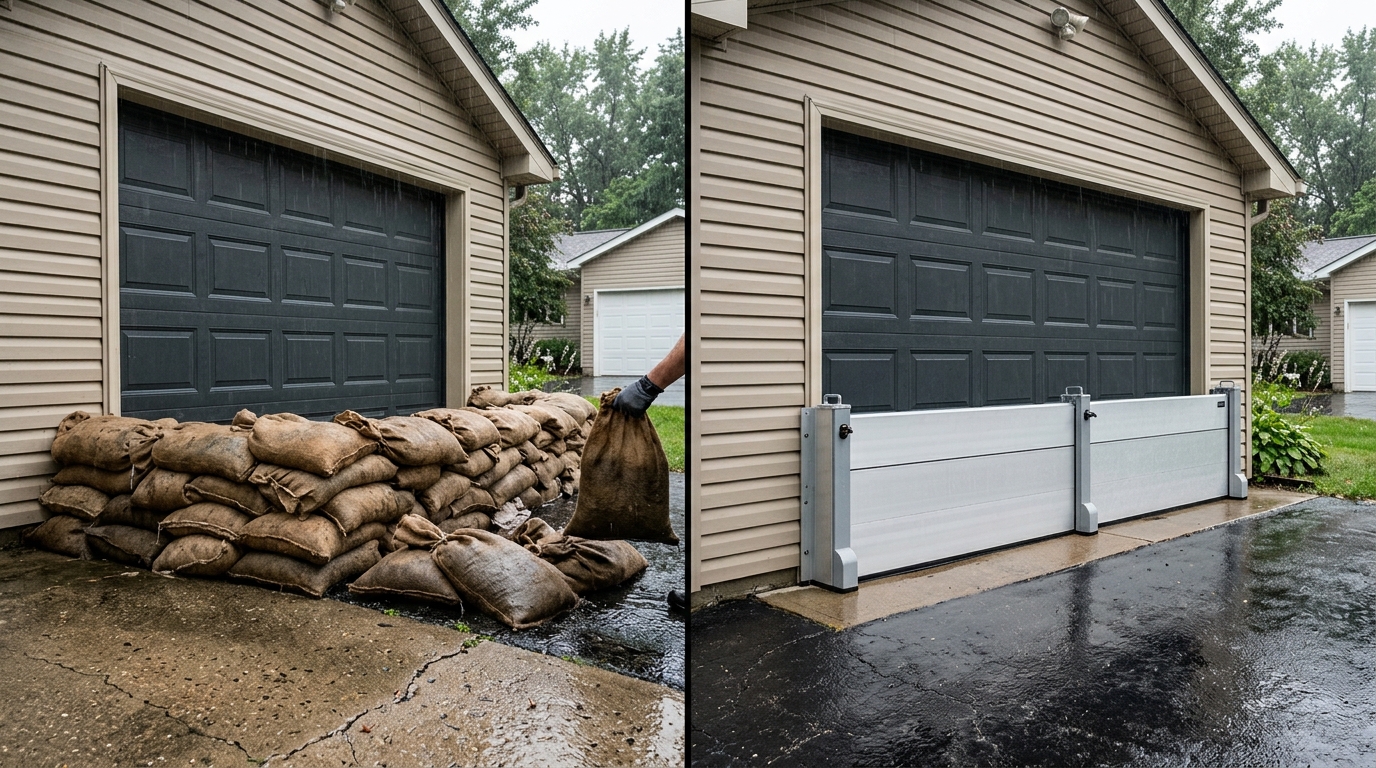
Both sandbags and purpose-built flood protection systems can have a place in a flood-preparation plan. The better choice depends on the property, expected flood conditions and how often the protection will be needed.
| Option | Advantages | Potential Limitations |
|---|---|---|
| Sandbags | Low-cost and widely recognized emergency option | Heavy, bulky and labor-intensive for wide garage openings |
| Flood Bags | Lighter and easier to handle than traditional sandbags | Reuse and storage depend on the specific product |
| Garage Door Flood Barrier | Designed specifically for protecting larger openings | Requires selecting a system suitable for the opening and installation conditions |
| Adjustable Garage Barrier | Can provide flexibility for larger or varying opening sizes | Must meet the manufacturer's size and installation requirements |
For a property that rarely experiences flooding, a temporary solution may be sufficient for some situations. For a garage that faces recurring flood risk, having a reusable system ready before severe weather arrives can make preparation much more straightforward.
What Should You Move Out of a Garage Before a Flood?
Flood protection should not rely entirely on keeping water outside. If flooding is possible, prepare the contents of the garage as well.
Move valuable or easily damaged items away from the floor whenever possible. This may include:
- Power tools
- Electrical equipment
- Appliances
- Important documents
- Household chemicals
- Furniture and stored belongings
- Seasonal equipment
- Items stored in cardboard boxes
If there is enough warning, vehicles should also be moved to a safer location when local emergency guidance recommends doing so.
Remember that floodwater can create electrical and contamination hazards. Do not enter or work in floodwater when doing so could put you at risk.
Don't Forget an Attached Garage
An attached garage deserves particular attention because it is connected directly to the home.
If water enters the garage, it may eventually reach interior doors, walls, utilities or other areas of the building. This means your flood-preparation plan should consider both the garage opening and the connection between the garage and the living areas.
FEMA guidance notes that attached garages can have specific floodplain requirements depending on their construction, location and relationship to the building's flood elevation. Requirements can also vary based on the flood zone and local regulations.
If your property is located in a regulated floodplain or you are making structural changes to the garage, check applicable local requirements and consult an appropriately qualified professional.
How to Prepare Your Garage Door for Flooding

The best time to prepare a garage door for flooding is before severe weather arrives. Waiting until water is already approaching the garage can leave you with very little time to find and install a suitable flood protection solution.
Start by identifying how water normally moves around your property during heavy rain. Look for areas where water collects near the garage, low points in the driveway, drainage problems and any other locations where water could move toward the garage opening.
Then consider the size of your garage door and the type of flood protection system that would work for that opening.
A simple preparation checklist includes:
- Measure the full width of the garage opening.
- Identify the direction water is likely to approach from.
- Check the surface where the flood barrier will sit.
- Determine how much water the garage may be exposed to.
- Choose a flood protection system suitable for the opening.
- Keep the system accessible rather than buried in storage.
- Review the installation instructions before an emergency occurs.
Taking these steps ahead of time makes it much easier to respond when heavy rain, hurricanes or flooding are expected.
Can You Protect a Wide Garage Door From Flooding?
Yes. Wide garage openings can be protected with flood barrier systems designed specifically for larger openings.
The important factor is choosing a system that is designed for the width of the garage door. A barrier intended for a standard doorway may not be suitable for a much wider garage opening.
For larger openings, an interlocking or expandable flood barrier can provide a practical solution because multiple sections can be connected to cover a wider area.
Trademark Hardware offers garage door flood barrier options for different opening widths, including systems designed for openings from 48 to 96 inches and larger openings from 96 to 144 inches.
Shop the Garage Door Dam for 48–96 inch openings
Shop the Garage Door Dam for 96–144 inch openings

What If Your Garage Opening Is Larger Than a Standard Door?
Not every garage has the same dimensions. Some residential garages have double-wide openings, while commercial properties and larger buildings may have significantly wider entrances.
If your garage opening is larger than a standard doorway, measure the opening carefully before selecting a flood barrier. The barrier needs to be appropriate for the width and configuration of the entrance.
For particularly wide openings, an oversized or interlocking flood barrier system may be more appropriate than trying to build a barrier from individual sandbags.
The goal is to create a continuous barrier across the opening rather than leaving gaps where floodwater can pass through.
Garage Flood Protection for Homes and Businesses
Garage flooding isn't limited to residential properties. Commercial buildings, warehouses, workshops and other properties can also have large ground-level openings that are vulnerable to flooding.
In a commercial setting, protecting a garage or large entrance can be especially important because water entering through a large opening can potentially damage equipment, inventory, vehicles, tools and other valuable property.
The same basic principles apply: identify the vulnerable opening, measure it accurately and select a flood protection system designed for the size and conditions of the entrance.
For wider openings, an interlocking garage door flood barrier can provide a more organized alternative to building a large wall of sandbags every time severe weather is expected.

What Is the Best Way to Protect a Garage Door From Flooding?
There is no single flood protection solution that is best for every garage. The right choice depends on the width of the opening, the expected flood conditions, the surface where the barrier will be installed and whether you need a temporary or reusable solution.
Sandbags can be useful as an emergency measure, but they require significant manual effort and storage space. Purpose-built garage door flood barriers are designed specifically around the problem of protecting larger openings and can be stored for repeated use.
For homeowners who experience seasonal flooding or live in areas affected by hurricanes and heavy rainfall, having a reusable barrier ready before the storm can make preparation much easier.
Garage Door Flood Barrier FAQs
How do I stop flood water from coming through my garage door?
You can use temporary solutions such as sandbags or flood bags, or install a purpose-built flood barrier designed for garage openings. The appropriate solution depends on the size of the garage opening, expected water level and site conditions.
Can you use a flood barrier on a garage door?
Yes. Flood barriers can be designed specifically for garage openings. Because garage doors are generally wider than standard residential doors, it is important to choose a system that is rated for the width of the opening you need to protect.
What is the best flood barrier for a garage?
The best garage flood barrier depends on the size and configuration of the garage opening and the flood conditions you are preparing for. For wider openings, interlocking garage door flood barriers can provide a reusable solution designed to cover larger areas.
How wide can a garage door flood barrier be?
The maximum width depends on the specific flood barrier system. Some systems are designed for standard garage openings, while interlocking systems can cover wider openings by connecting multiple sections. Always check the manufacturer's specifications before selecting a barrier.
Are garage door flood barriers reusable?
Many purpose-built flood barriers are designed for repeated use. After the flood risk has passed, the barrier can be removed, cleaned or dried according to the manufacturer's instructions and stored for future use.
Are sandbags better than a garage door flood barrier?
Sandbags can be useful for temporary emergency protection, but they are heavy, bulky and labor-intensive. A purpose-built garage door flood barrier is designed specifically for the opening and can provide a reusable alternative that is easier to prepare and store.
Can I protect a double garage door from flooding?
Yes. A double garage door can be protected, but the barrier must be suitable for the full width of the opening. Measure the opening before choosing a system and consider an interlocking or oversized flood barrier when additional width is required.
How do I know what size garage flood barrier I need?
Start by measuring the width of the opening where the barrier will be installed. You should also consider the threshold, ground surface, surrounding walls and expected flood conditions. Select a system that is designed for the measured opening rather than relying on an approximate size.
Can a garage flood barrier protect against hurricanes?
A suitable flood barrier can be part of a property's flood-preparation plan during hurricanes and tropical storms. However, no flood protection product should be treated as a guarantee against every flooding situation. Always follow the manufacturer's specifications and local emergency guidance.
Choose the Right Garage Flood Protection Before the Next Storm
Protecting a garage from flooding starts with understanding how water can reach the opening and choosing a solution that fits the property.
For some situations, sandbags or flood bags may provide temporary protection. For homeowners and businesses that want a reusable solution specifically designed for larger openings, a garage door flood barrier can make flood preparation faster and more manageable.
Before choosing a system, measure your garage opening, consider the expected flood conditions and make sure the barrier is appropriate for the surface where it will be installed.
Most importantly, don't wait until floodwater is already approaching the garage. Having your flood protection system ready ahead of time gives you a much better opportunity to install it properly before the situation becomes an emergency.
Shop Garage Door Flood Barriers

Trademark Hardware offers flood protection solutions designed for garage doors and larger openings. Depending on the size of your garage, you can choose from different barrier configurations designed to accommodate a range of opening widths.
Garage Door Dam Flood Barrier for 48–96 inch openings
Garage Door Dam Flood Barrier for 96–144 inch openings
For larger or unusual openings, you can also explore the Oversized Door Dam Flood Barrier.
If you need additional flood protection for other entrances around your property, you can also explore Trademark Hardware's flood barrier options.
Prepare before the next storm, measure your opening and choose the flood protection system that fits your property.
